Unsubscribe
View in your browser
Manchester Homelessness Partnership
E-bulletin - December 2025

So you can receive our e-bulletin, please mark us as a safe-sender and not junk mail. Thank you.

Ministry of Housing, Communities and Local Government - National Plan to End Homelessness 

The National Plan to End Homelessness was launched on 11 December 2025, and will support the most vulnerable people in our society.

The National Plan can be read in full here. 

Here are two responses to the national plan from the Centre for Homelessness Impact and Pathway: 

Centre for Homelessness Impact
The release of the government's new Plan to End Homelessness is an important milestone. While not perfect, the focus on working across government, the recognition of homelessness as a systemic issue, and the continued commitment to data and research is crucial. Their Chief Executive, Lígia Teixeira, discusses some of the key takeaways from the strategy and makes the case for a clear and meaningful focus on prevention, backed up by the funding to help local areas understand what works to better prevent crises.

Pathway - Homeless and Inclusion Health
They were delighted to see a firm commitment to ending the unacceptable practice of discharging people from hospital to the street. Pathway - Homeless and Inclusion Health has long called for this vital and overdue change, and we welcome the Government’s clear recognition that street discharge is a ‘’deeply harmful outcome’’.
They also welcomed several ambitions set out in the plan:
✅ Improving existing funding streams to support specialist intermediate care.
✅ Embedding housing officers in hospital discharge teams.
✅ Improving access to care and challenging the stigma people facing homelessness often experience.

Our Action Groups

Physical Health and Mental Ill Health Action Group 
We will be holding the next meeting face to face at Cornerstone on Thursday 22 January from 2pm to 3.30pm. This will be the first meeting since joining the physical and mental health action groups, so we will be focusing on adjusting the terms of reference if necessary and discussing what both groups have been working on and deciding what to focus on for future sessions. If you are interested in attending, please email Sophie at s.garforth@caritassalford.org.uk .

Women's Homelessness Involvement Group (WHIG)
The next meeting will be taking place on Thursday 29 January from 2pm to 3pm at the Booth Centre.
During this session, they will be:
- Continuing to explore the different options for the WHIG poster and logo
- Begin creating the WHIG homelessness booklet
- Sharing ideas, gathering feedback, and planning next steps for the project
Please bring along any drafts, sketches, or ideas you’ve been working on.

Real Change MCR Funding Panel 
Thanks to Gabe Erinle, Game Facilities Management who volunteers on the funding panel and kindly stepped in to do a BBC Radio Manchester interview about Real Change MCR. He was able to talk about the various Christmas fund raisers including our partnership working with Street Smart and the Manchester markets team.   

Thank you to Jack Dorney, Encore who raised £1400 for Real Change MCR from the sale of raffle tickets at their Christmas party. 

Health and Homelessness

Bridging the Gap - Health and Homelessness Event
Click here to read our Health and Homelessness Event report from the open meeting held in September 2025. This report is now being shared with action groups for next steps and actions. If you have any questions or queries, please email val@macc.org.uk

Pathway - Homelessness and Inclusion Health 
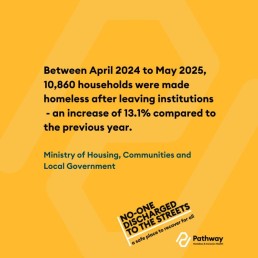
Government statistics recently published show a sharp rise in people becoming homeless after leaving institutions, including hospitals. Between April 2024 and March 2025, 10,860 households were made homeless after leaving institutions, an increase of 13.1 per cent compared to the previous year. Hospitals have a major contribution to make in both preventing and responding to homelessness. But too often, opportunities are missed. Recent research from Homeless Link shows that 32 per cent of people experiencing homelessness who spend time in hospital are discharged to the street – a one-third increase from the previous phase of the study.
But there is good news: Pathway know what works.
- Specialist hospital-based teams reduce returns to rough sleeping by 62 per cent and to sofa surfing by 33 per cent.
- Specialist intermediate care services can reduce returns to rough sleeping by 70 per cent.
The Government has a major opportunity to break this upward trajectory and bring an end to street discharge. To make this a reality, Pathway is calling on the Government to use the forthcoming cross-government homelessness strategy to implement these life-changing interventions.

Greater Manchester Urgent Dental Care Telephony Service
Hours of operation are from 8am-10pm, 7 days a week.
Who is eligible to use this service? All residents of Greater Manchester and temporary visitors to the area, however daytime appointments are only available to patients without a dentist. Evening/weekend/Bank Holiday appointments are available to all Greater Manchester residents who require urgent dental treatment or advice. Following triage, patients will be offered a same day or next day appointment, given advice or signposted to other services. Appointments are confirmed by text message.
What happens from 10pm to 8am when the new telephony service is not available? Patients can still call NHS 111 for urgent dental advice. If patients do call NHS 111 with a dental issue between 8am and 10pm they will automatically be redirected to the Greater Manchester Urgent Dental Care Telephony Service.

New Alcohol Guidelines from Department of Health and Social Care (DHSC)
DHSC has developed evidence-based guidelines in collaboration with the devolved governments. A group of UK senior clinical experts and a group of people with lived experience of alcohol problems advised on their content. The guidelines recommend interventions for people with harmful patterns of drinking and alcohol dependence, outlining good practice to improve outcomes for people in need.
The guidelines are for clinicians and professionals who deliver alcohol interventions in specialist alcohol and drug treatment services and in hospitals and other health and care settings. They are also for other professionals, such as homelessness workers, who support people with alcohol problems in the course of their work.
They provide detailed descriptions of good practice that commissioners and providers can use to inform service design and delivery, staff training and quality assurance.

Homeless Link - Delivering integrated health and social care services for people experiencing homelessness
Across all forms of health care needs, both physical and mental, people experiencing homelessness report poorer diagnoses and greater barriers to accessing healthcare support than the general population, as evidenced in the Unhealthy State of Homelessness report. The number of people with a mental health diagnosis increased substantially from 45 per cent in 2014 to 82 per cent in the 2018 – 2021 research cohort, while 63 per cent of respondents from this cohort reported they had a long-term illness, disability or infirmity. The average age of death of someone experiencing homelessness is around 30 years lower than that of the general population.

In 2022 the National Institute for Health and Care Excellence (NICE) published guidelines on how to deliver integrated health and social care services for people experiencing homelessness (NG214). They aimed to improve access to and engagement with health and social care, and ensure care is coordinated across different services. In response, a series of six case studies exploring services that exemplify best practice in delivering the NICE guidelines have been developed by the Homeless Health Consortium (HHC). The case studies illustrate how collaboration across the health and homelessness sectors can effectively reduce health inequalities. This resource was updated in October 2025.

Children, Young People and Homelessness

Centrepoint - Launch of the Early and Extra Help Service
Centrepoint is delighted to invite you to the launch of their Early and Extra Help Service, alongside their other key services in Manchester. This event will be an opportunity to learn more about the support available, meet colleagues, and explore how we can work together to strengthen provision for young people in Manchester.
Date: 20 January
Time: 9am - 10.30am
Location: Centrepoint 52 Oldham Street Manchester M4 1LE
The launch will include:
- An overview of Extra and Early Help services
- An overview of Centrepoint's offer for young people
- Opportunities for networking and collaboration

Policy Brief: Local Authority Gatekeeping Report (Centrepoint)
Under the Homelessness Reduction Act 2017 (HRA), everyone in England approaching their local authority for help because they are homeless or at risk of homelessness is entitled to an assessment. However, Centrepoint’s latest Youth Homelessness Databank found that a third of the young people who approached their local authority in England in 2023/24 were not assessed for eligibility. To read the report in full please click here

Women and Homelessness

Homeless Link - The Gendered Lens Framework
Homeless Link have produced a
 Gendered Lens Framework to support homelessness services to responds effectively to women. The Gendered Lens Framework asks services to consider the impact of gender on a person’s experience of homelessness and ability to access the service. It includes seven approaches to service design and delivery:

- co-production
- valuing relationships
- working together
- intersectional
- actively inclusive
- trauma-informed
- safer spaces

They have created a series of bitesize videos (5-10 minutes) for homelessness professionals to understand the impact of gender on women and the steps they can take to embed a gendered lens through approaches to service design and delivery.

Migration and Homelessness

NACCOM - National Data Briefing
NACCOM has launched their new Annual Survey data briefing for 2024-25, which reveals that thousands of people in the UK's asylum and immigration system are facing a growing crisis of destitution and homelessness as a direct result of hostile and ever-changing policies from consecutive governments. Their shows that Government policy is causing an entrenched migrant homelessness crisis, with no let up in soaring levels of homelessness and destitution.
Some key findings:
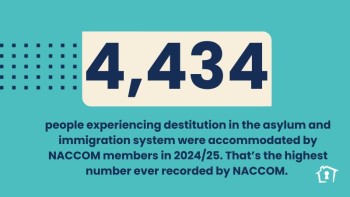
? There is an entrenched migrant homelessness crisis. NACCOM’s network of frontline members accommodated 4,434 people – more than in any previous year since our records began in 2013.
? Refugees are being failed by statutory services and a shortened move-on period. Despite being entitled to access some form of state support, 2,008 refugees were accommodated by the network this year, a 3 per cent increase on 2023/24 and a 106 per cent increase on 2022/23.
? NRPF conditions are forcing people into destitution. NACCOM members accommodated 1,509 people with restricted eligibility or No Recourse to Public Funds (NRPF) in 2024/2025.
⚖️ Charities can’t plug the gap caused by the legal aid emergency. 64 per cent of NACCOM members said they were unable to meet the rise in demand for legal advice.
You can read the full data briefing here. 

LGBTQIA+ and Homelessness

Our Room - Celebrating 2025 -  A creative community for male, trans and non-binary people who sex work  
A message from their Interim CEO, Rob Cookson.

Single Homeless Project - Why are LGBTQIA+ people more likely to be homeless?
Research by organisations like AKT, Stonewall, and Mind shows that LGBTQIA+ people are more likely to be homeless. Almost one in five LGBTQIA+ people have, at some point, been homeless. So, what are the reasons?
Discrimination and violence
LGBTQIA+ homeless people face more discrimination and violence on the street and after being supported.
- Sleeping on the street is particularly dangerous for LGBTQIA+ people. As of 2023, hate crimes based on sexual orientation have risen 112% in five years. Hate crimes against transgender people have increased by 186% in the same period.
- Sexual assault rates are much higher for LGBTQIA+ people. Young LGBTQIA+ homeless people are sexually assaulted at three times the rate of their non-LGBTQIA+ peers.
- Hostels and temporary housing often cannot meet LGBTQIA+ people’s needs, especially transgender people. Many services are gendered, making it difficult for transgender people to find appropriate support.
- Even after support, LGBTQIA+ people, particularly transgender people, are at a higher risk of aggression and sexual assault in hostels.
You can read further information on their Homelessness Explained page here.

From Struggle to Strength: Sarah's Journey 

When Sarah first came to Barnabus five years ago, life was incredibly tough for her. She was caught in the cycle of addiction and often prioritised substances over her health and wellbeing. Despite every offer of support, from seeing their nurse, to accessing showers, to attending recovery and mental health groups, Sarah wasn’t ready to take that step towards change. During this time, she struggled with self-neglect and was unable to engage with the help that was available. Sarah was in and out of their support centre for five years but they stuck by her side and explained that they would always be there for her when she’s ready to engage and accept help. During this time, she struggled with self-neglect and was unable to engage with the help that was available. Click here to read Sarah's story.

Blogs, Evidence Note, Guidance, Podcast and Reports 

Centre for Homelessness Impact - A first look at latest data on statutory homelessness in England 
Homelessness pressures are far from uniform across England, as seen in new data released from the Ministry for Housing, Communities and Local Government (MHCLG) on 27 November 2025. The Centre for Homelessness Impact will be releasing a series of insights and data visualisations discussing the statutory homelessness statistics for the financial year 2024-25. 
First they have examined prevention and relief duties across England.
When local authorities assess households under homelessness legislation, they're required to offer support through two initial duties. The prevention duty applies to households threatened with homelessness and the relief duty applies to households who are already experiencing homelessness.
Key takeaways:

- The North East's consistently high rates across both duties, despite its small population of just 1.2 million households, signals concentrated housing insecurity that demands urgent attention.
- London continues to lead with the highest rates across both duties.
- The South East records the lowest relief duty rate despite its geographic proximity to London, highlighting how dramatically housing pressures can vary even between neighbouring regions.
The national picture:
- 360,050 households assessed for homelessness duties (up 18.3 per cent over 5 years)
- 147,870 owed prevention duty (threatened with homelessness)
- 182,540 owed relief duty (experiencing homeless)
Prevention duties per 1,000 households: London leads at 7.7, followed by the North East at 7.4, despite being England's smallest region by population. West Midlands recorded the lowest rate at 4.7. Access the interactive visual here.
Relief duties per 1,000 households: The regional gap widens for households already experiencing homelessness. London recorded 11.5 per 1,000, North East 9.0, and North West 8.3. The South East had the lowest rate at 5.3, less than half London's rate. Access the interactive visual here.

Centre for Homelessness Impact - What happens to households when statutory support ends?
The Centre for Homelessness Impact has looked at more data from MHCLG's latest annual statutory homelessness figures for England to get a better understanding.
When local authorities assess households under homelessness legislation, they're required to offer support through two initial duties; the prevention duty applies for households threatened with homelessness and the relief duty for households already experiencing homelessness.
Here are some key takeaways from the data on the outcomes of these duties:
- Success rates are declining for both prevention and relief duties, with relief duties showing particularly poor outcomes, as the system is increasingly struggling to secure stable housing for households in crisis.
- Only 52 per cent of prevention duties ended with households securing or sustaining accommodation (74,600 out of 143,710 households). While marginally up from 51 per cent last year, this represents a five-year decline from 58 per cent in 2019-20.
- When prevention duties succeeded, the most common interventions were accommodation secured by local authority or housing options service (30 per cent of successful interventions), help securing accommodation found by applicants without financial payment (12 per cent), and help securing accommodation with financial payment (12 per cent). Click here to see the diagram. 
- Only 31 per cent of relief duties ended with households securing accommodation for six months or more (67,360 out of 219,450 households). This has declined steadily over five years, falling from 40 per cent.
- Among successful relief duty outcomes, accommodation secured by local authority or housing options service was the primary intervention (49 per cent), followed by supported housing (14 per cent) and help securing accommodation with financial payment (11 per cent). Click here to see the diagram.

Greater Manchester Live Well Podcast
What if support really started with people not systems? The Greater Manchester Live Well Podcast explores a bold new way of doing things with communities: with people, not to them. A helping hand, not a hoop to jump through. Working together to ensure everyone has access to great everyday support. Hear real stories from residents, leaders and changemakers reshaping public services with heart and hope. For anyone who believes in a better way - communities leading change, supported by public services. Created by Greater Manchester Live Well with voices from across the city region.

Resources and Training

Frontline Worker Insight Session on Temporary Accommodation
The Manchester Homelessness Partnership Temporary Accommodation Action Group is hosting a focused insight session for VCFSE frontline workers who support people living in temporary accommodation.

Wednesday 21 January, from 1pm to 3pm at the Booth Centre, Pimblett Street, Cheetham Hill, M3 1FU. 

A light lunch will be provided.

Frontline workers often find themselves navigating tricky, time-sensitive issues in temporary accommodation, and we know this can create pressure on both support organisations and the council. This session is a chance to share what you’re seeing on the ground, so together we can spot where clearer information or smoother processes might help reduce stress for everyone involved.

We’ll be exploring:
- The common reasons you’re contacting the council on behalf of clients in temporary accommodation — what questions you’re asked most often, where information feels hard to find, and what tends to slow things down.
- The practical frustrations that could be eased with more consistent communication, clearer guidance or simple shared tools.

What we gather will help us co-create:
- A shared Frequently Asked Question list
- Practical resources for support organisations and community groups.
- Suggestions that can support future improvements to how the system works for all sides.

Your experience is essential. By pooling insights we can help make things a little easier for everyone supporting people in temporary accommodation across Manchester. If you can join us, we’d love to have you there.

Interested in attending, please email val@macc.org.uk

GM Resilience Hub - Free training session on trauma informed working
This training will take place on Tuesday 27 January from 10am to 1pm at St Thomas Centre, Ardwick, M12 6FZ. It is open to VCFSE staff working in homelessness in Manchester and staff from Manchester City Council homelessness directorate. Please share this information with your colleagues who may be interested in attending. There are 30 spaces available. Refreshments and a light lunch will be provided.

The training includes:

- Exploring potentially traumatic incidents encountered within their roles, and linking this into a message around the importance of taking care of themselves
- Education re what is trauma, vicarious trauma, acute trauma, secondary trauma
- Trauma responses (symptoms)
- Thinking together about the things that help to mitigate the impact of trauma at work
- How to take care of ourselves, and look out for our colleagues, after potentially traumatic incidents
- Think together about what they need going forwards/how they can support each other

If you are interested in attending, please email Val at val@macc.org.uk 

Pathway Masterclass - Understanding and Addressing PTSD and Complex Trauma in Homelessness
This online masterclass is taking place on Tuesday 27 January from 3.30pm to 5pm. Click here to read further information and book a place. 

Greater Manchester Good Landlord Charter Private Rented Sector Assessment Framework
This
document explains exactly what Private Rented Sector landlords are required to do and demonstrate to become a Member of the Greater Manchester Good Landlord Charter. It will be accompanied by a guide for landlords and tenants. There will be additional Assessment Frameworks for other landlords, specifically within the Social Housing, Supported, Temporary (not hotels and B&Bs), and Student sector.

Employment Opportunities

Shared Health Foundation - Health Inequalities Policy Officer
Role title: Health Inequalities Policy Officer
Contract type: Fixed-term or permanent, Part-time (30 hours)
Location: Office based in Oldham, Greater Manchester with travel around the UK.
Start date: January 2026
Salary: £28-30k depending on experience. (FTE, pro rata 30 hours)
For an informal discussion around this role, please email sam.pratt@sharedhealth.org.uk
Application deadline: Monday 5th January 2026

Have your say 

Have your say on Manchester City Council 2026/2027 budget proposals
The Council will set a budget for 2026/27 that looks to the future with confidence – not just protecting frontline services but investing in the things you’ve told them matter the most to you and building back some of the things that were hit by austerity. This is symbolic after years of disproportionate cuts to our budgets by the previous government.  Over the coming months, they will bring forward proposals to make Manchester better, including investment in extended library opening hours, enhanced youth services, more cash for community groups, and strengthening services to clean our streets and crack down on fly-tipping. They will also continue to invest in tackling poverty and supporting people into good jobs. Click here to read further information and provide your feedback.

Including the voice of Lived Experience in policy making 
The Greater Manchester Equality Alliance has created a set of key principles to ensure the voice of lived experience can be meaningfully included and heard in policymaking, examples of best practice and remuneration considerations. You can read the 2 page document here. You can share your thoughts on the key principles here. 

Volunteer Opportunities

Volunteer Centre Manchester
The Volunteer Centre Manchester provides information, support and training to Manchester residents who want to volunteer and to organisations that work with or involve volunteers.

Niall's Corner

Thanks to Niall for his work in collating the following information about homelessness services and their Christmas openings.

- Christmas opening times

- Map of Street Homelessness services

- Greater Manchester out of hours contacts

Here is a dynamic link to Niall's Greater Manchester 301
foodbanks and pantry list. 

E-bulletins, Events and News

E-bulletins

Manchester City Council - Work and Skills Bulletin - 1 December 2025 8 December 2025 11 December 2025 22 December 2025

Manchester Community Central - Training E-bulletin - 27 November 2025 Training E-bulletin - 19 December 2025

Boaz Trust - December Update

Manchester Active Voice - Issue 123 Issue 124

News

Homeless Link - What the Budget means for homelessness and homelessness services - 28 November 2025

Homeless Link - Homeless Link joins call for Local Housing Allowance rate uplift - 26 November 2025

Centre for Homelessness Impact - R&D is the missing engine of homelessness prevention - 24 November 2025

Centre for Homelessness Impact - Why homelessness needs better evidence, and why misrepresenting serious efforts helps no one - 8 December 2025

Migrant Destitution Fund - How the government’s latest plans will force more people into destitution - 8 December 2025

BBC News - Hidden homeless: 'I slept on buses and in front of security cameras' - 11 December 2025 

Homeless in Manchester

Here you can find advice, information and support if you are homeless in Manchester. Here is a list of voluntary and community organisations working across the city to help and support people and families experiencing homelessness. You can report a person sleeping rough via Streetlink and connect them with local support services.

Real Change MCR

Real Change MCR is a fund to help people experiencing homelessness in Manchester pay for practical items that they need to build lives away from the streets. The fund is used by Manchester homelessness organisations and charities who provide long-term support on the journey to independent living.
Acts of kindness and generosity have been shown to have positive effects on both mental and physical health. What can you do today to help raise funding for Real Change MCR?

Manchester Homelessness Partnership Welsh loves coffee Network and Communications Worker
Contribute and have your say on our newsletter

Want to contribute to the Manchester Homelessness Partnership newsletter? 

Send over any events, funding opportunities, news or resources that we can share with the network, to help us in our aim of tackling homelessness in Manchester. 

We also welcome constructive and positive feedback. Please email Val at val@macc.org.uk or call on 07702-668169.

 Facebook  Web  Linkedin  Instagram